
Evony: The King’s Return Shooting Ads Review: Get Players and Keep Them
Mobile strategy games fight for attention every single second. Open any app store today, and you’ll see dozens of ads screaming for a thumb-stop. Some show cities burning. Some show generals shouting orders. Most blur together after the third scroll.
Here’s the shift worth noting: developers have stopped explaining their games in ads. They compress power fantasy instead. Show a crisis. Offer one fast choice. Prove visible growth. Invite the viewer to try it themselves. Four beats, fifteen seconds, done.
Short video hooks now pair with interactive formats, and creative teams refresh constantly to dodge fatigue. Why? Because the market moves fast. SocialPeta’s mid-2025 data puts it plainly: nearly 7,000 new mobile game advertisers entered the field each month in the first half of the year. Seven thousand. Every month. That’s not a crowded room. That’s a stampede.
So how does a strategy game stand out in such a saturated ad landscape? Evony: The King’s Return (hereafter referred to as Evony) offers a useful case study, not because it invented the playbook, but because it committed early and kept iterating.
Evony’s Bold Bet: The Super Bowl Play
Back in 2017, Evony did something few mobile strategy titles dared to try. It bought Super Bowl airtime. The 30-second spot, “The Battle of Evony,” starred Aaron Eckhart, Jeffrey Dean Morgan, and Fan Bingbing.
The ad didn’t just run once and disappear. It won the Exemplary Cinematography Merit Award for Super Bowl Commercials from The One Show, a recognized honor in the advertising world. It reflects a production team that understood cinematic pacing, cast chemistry, and how to compress a strategy game’s core tension into half a minute.
What did that campaign actually do for Evony? The exposure was massive. Store rankings climbed. Curious players who’d never touched a 4X strategy title suddenly gave Evony a shot. A calculated risk, sure, but one that paid off in visibility and trust. Ads at that scale tell players something before a single line of copy does: this game is worth your attention.
Evony Ads in 2026: Barrel-Breaking, Number-Crunching
Fast forward to now. Evony’s current ad rotation leans on a different format entirely, one built for thumb-scrolling attention spans rather than cinema screens.
Picture a character walking down a lane. Barrels roll toward them, each one stamped with a number. Shoot the number down to zero before the barrel reaches you, or get crushed. That’s the whole pitch. In the ad-buying world, this style has a name: the runner-plus-multiplier target shooter.
Three reasons, and they’re worth breaking down. Compared to most mobile game ads cluttering the same feed, this format strips everything down to one clear loop.
Why does it work?
First, comprehension is instant—no tutorial, no menu, no jargon. For example, a viewer sees “500” on a barrel and “+10 damage” on an upgrade prompt, and understands the stakes within two seconds. Compare that to explaining tech trees or city management. There’s no comparison. Simplicity wins the scroll.
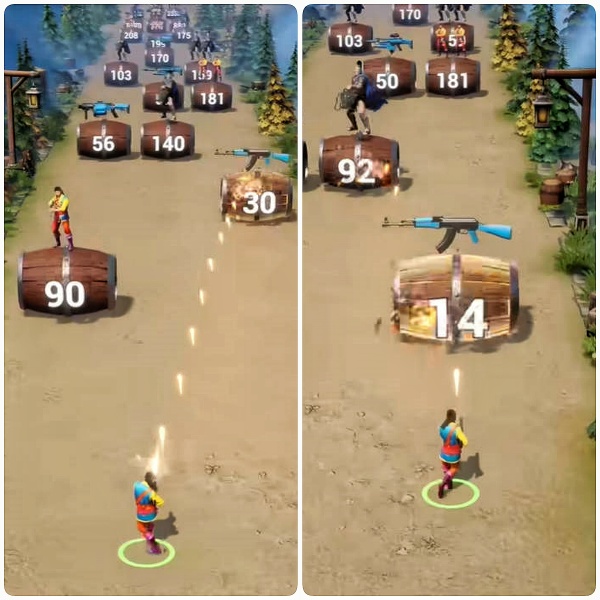
Second, the numbers make growth visible. Watching damage output drop from 1,000 to 800 to 300 turns an abstract idea- getting stronger- into something you can track in real time. Bullet flies. Number falls. Barrel bursts. Reward drops. Weapon upgrades. Repeat. That loop is satisfying to watch even before anyone taps install.
Third, and this is the part that really hooks people: the near-miss. These ads love showing a character one bullet away from breaking the barrel, then getting flattened at the last inch. Brutal. Unfair, almost. And that’s exactly the point. Viewers hate watching a fictional failure they know they could’ve prevented. That itch, “I can do better,” drives clicks. It drives downloads. It’s psychological bait, and it’s remarkably effective bait.
Add the physical crush moment itself. A barrel rolling over a character hits harder, visually, than a health bar quietly draining to zero. It’s blunt. It’s visceral. And in a feed full of muted animations, that kind of impact stops thumbs cold.
Where Ads End and the Game Begins
Here’s the catch nobody should skip: great ads only get someone to tap install. After all, they won’t keep anyone playing past week one.
Smart developers already know this. In fact, the best ones measure success well beyond the ads themselves. While click-through rate and cost-per-install look impressive on a dashboard, they fail to tell you who actually enjoys the game. So, what really matters? Tutorial completion. First-session depth. How many new players actually join an alliance. Day-one and day-seven retention. Ultimately, these are the signals that separate a curious tap from a genuine strategy fan.
Granted, Evony’s ads, whether cinematic or barrel-based, do a fantastic job of pulling attention. Yet, what keeps millions of players coming back day after day isn’t a 30-second clip. It’s the core gameplay loop underneath: city-building that rewards patience, alliance systems that reward teamwork, generals and civilizations that reward experimentation, and a technical foundation stable enough to support it all without breaking.
Ads open the door. Get it? The game has to be worth walking through.